Press "Enter" to skip to content

Huahua's Tech Road

花花酱 LeetCode 1339. Maximum Product of Splitted Binary Tree

Given a binary tree root. Split the binary tree into two subtrees by removing 1 edge such that the product of the sums of the subtrees are maximized.

Since the answer may be too large, return it modulo 10^9 + 7.

Example 1:
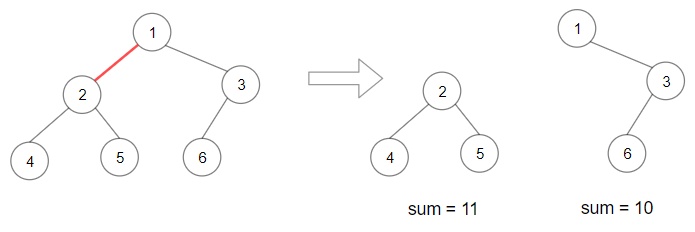
Input: root = [1,2,3,4,5,6]
Output: 110
Explanation: Remove the red edge and get 2 binary trees with sum 11 and 10. Their product is 110 (11*10)

Example 2:
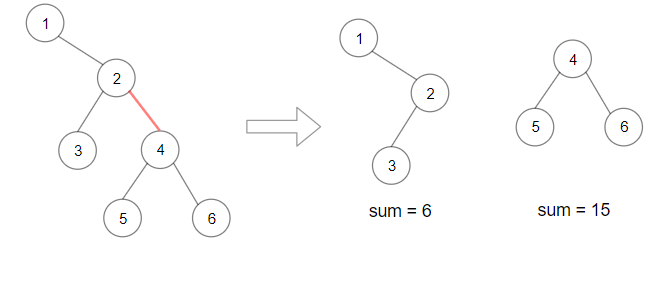
Input: root = [1,null,2,3,4,null,null,5,6]
Output: 90
Explanation:  Remove the red edge and get 2 binary trees with sum 15 and 6.Their product is 90 (15*6)

Example 3:

Input: root = [2,3,9,10,7,8,6,5,4,11,1]
Output: 1025

Example 4:

Input: root = [1,1]
Output: 1

Constraints:

  • Each tree has at most 50000 nodes and at least 2 nodes.
  • Each node’s value is between [1, 10000].

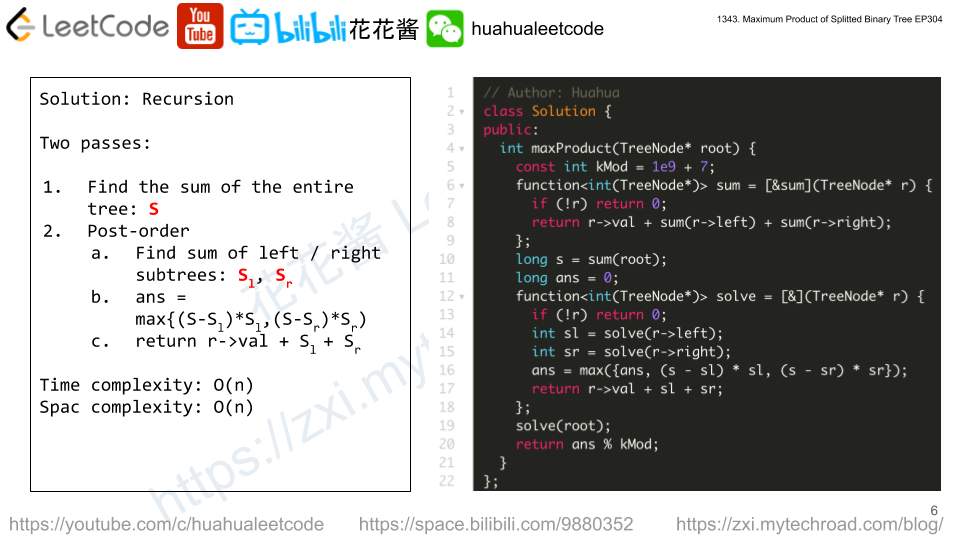
Solution: Recursion
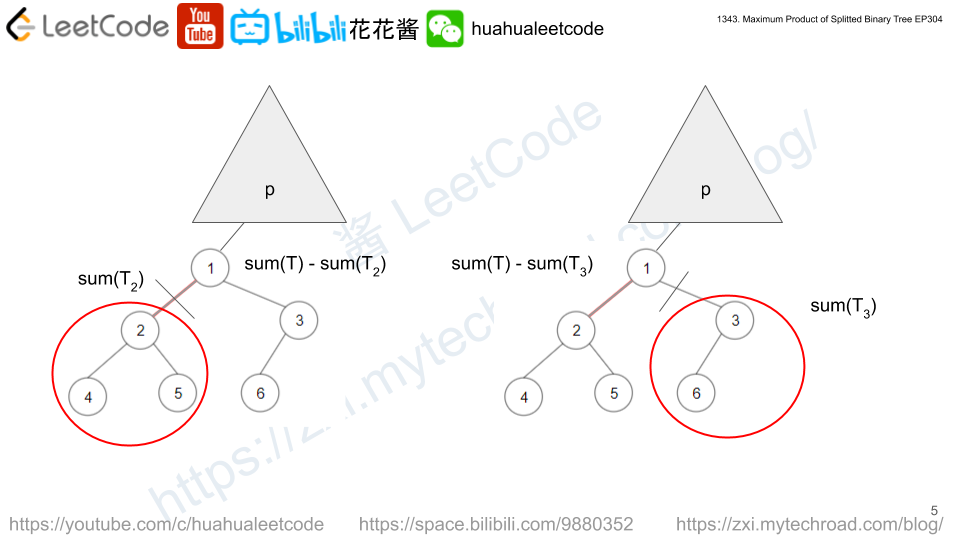
Two passes:
First pass, compute the sum of the entire tree S.
Second pass, for each node, compute the sum of left/right subtree S_l, S_r.
ans = max{(S – S_l) * S_l, (S – S_r) * S_r}

Time complexity: O(n)
Space complexity: O(n)

C++

花花酱 LeetCode 912. Sort an Array

Given an array of integers nums, sort the array in ascending order.

Example 1:

Input: nums = [5,2,3,1]
Output: [1,2,3,5]

Example 2:

Input: nums = [5,1,1,2,0,0]
Output: [0,0,1,1,2,5]

Constraints:

  • 1 <= nums.length <= 50000
  • -50000 <= nums[i] <= 50000

Since n <= 50000, any O(n^2) won’t pass, we need O(nlogn) or better

Solution 1: QuickSort

Time complexity: O(nlogn) ~ O(n^2)
Space complexity: O(logn) ~ O(n)

C++

Solution 2: Counting Sort

Time complexity: O(n)
Space complexity: O(max(nums) – min(nums))

C++

Solution 2: HeapSort

Time complexity: O(nlogn)
Space complexity: O(n)

C++

C++

Solution 3: MergeSort

Time complexity: O(nlogn)
Space complexity: O(logn + n)

C++

Solution 4: BST

Time complexity: (nlogn)
Space complexity: O(n)

C++

花花酱 LeetCode 1302. Deepest Leaves Sum

Given a binary tree, return the sum of values of its deepest leaves.

Example 1:

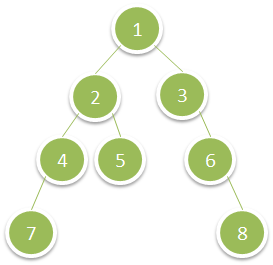
Input: root = [1,2,3,4,5,null,6,7,null,null,null,null,8]
Output: 15

Constraints:

  • The number of nodes in the tree is between 1 and 10^4.
  • The value of nodes is between 1 and 100.

Solution 1: Recursion

Time complexity: O(n)
Space complexity: O(n)

C++

花花酱 LeetCode 162. Find Peak Element

A peak element is an element that is greater than its neighbors.

Given an input array nums, where nums[i] ≠ nums[i+1], find a peak element and return its index.

The array may contain multiple peaks, in that case return the index to any one of the peaks is fine.

You may imagine that nums[-1] = nums[n] = -∞.

Example 1:

Input: nums = [1,2,3,1]
Output: 2
Explanation: 3 is a peak element and your function should return the index number 2.

Example 2:

Input: nums = [1,2,1,3,5,6,4]
Output: 1 or 5 
Explanation: Your function can return either index number 1 where the peak element is 2, or index number 5 where the peak element is 6.

Solution: Binary Search

Time complexity: O(logn)
Space complexity: O(1)

C++

花花酱 LeetCode 35. Search Insert Position

Given a sorted array and a target value, return the index if the target is found. If not, return the index where it would be if it were inserted in order.

You may assume no duplicates in the array.

Example 1:

Input: [1,3,5,6], 5
Output: 2

Example 2:

Input: [1,3,5,6], 2
Output: 1

Example 3:

Input: [1,3,5,6], 7
Output: 4

Example 4:

Input: [1,3,5,6], 0
Output: 0

Solution: Binary Search

Find the number or upper bound if doesn’t exist.

Time complexity: O(logn)
Space complexity: O1)

C++