Given an integer array nums(0-indexed) and two integers target and start, find an index i such that nums[i] == target and abs(i - start) is minimized. Note that abs(x) is the absolute value of x.
Return abs(i - start).
It is guaranteed that target exists in nums.
Example 1:
Input: nums = [1,2,3,4,5], target = 5, start = 3
Output: 1
Explanation: nums[4] = 5 is the only value equal to target, so the answer is abs(4 - 3) = 1.
Example 2:
Input: nums = [1], target = 1, start = 0
Output: 0
Explanation: nums[0] = 1 is the only value equal to target, so the answer is abs(0 - 0) = 1.
Example 3:
Input: nums = [1,1,1,1,1,1,1,1,1,1], target = 1, start = 0
Output: 0
Explanation: Every value of nums is 1, but nums[0] minimizes abs(i - start), which is abs(0 - 0) = 0.
There is a hotel with n rooms. The rooms are represented by a 2D integer array rooms where rooms[i] = [roomIdi, sizei] denotes that there is a room with room number roomIdi and size equal to sizei. Each roomIdi is guaranteed to be unique.
You are also given k queries in a 2D array queries where queries[j] = [preferredj, minSizej]. The answer to the jth query is the room number id of a room such that:
The room has a size of at leastminSizej, and
abs(id - preferredj) is minimized, where abs(x) is the absolute value of x.
If there is a tie in the absolute difference, then use the room with the smallest such id. If there is no such room, the answer is -1.
Return an array answer of length k where answer[j] contains the answer to the jth query.
Example 1:
Input: rooms = [[2,2],[1,2],[3,2]], queries = [[3,1],[3,3],[5,2]]
Output: [3,-1,3]
Explanation: The answers to the queries are as follows:
Query = [3,1]: Room number 3 is the closest as abs(3 - 3) = 0, and its size of 2 is at least 1. The answer is 3.
Query = [3,3]: There are no rooms with a size of at least 3, so the answer is -1.
Query = [5,2]: Room number 3 is the closest as abs(3 - 5) = 2, and its size of 2 is at least 2. The answer is 3.
Example 2:
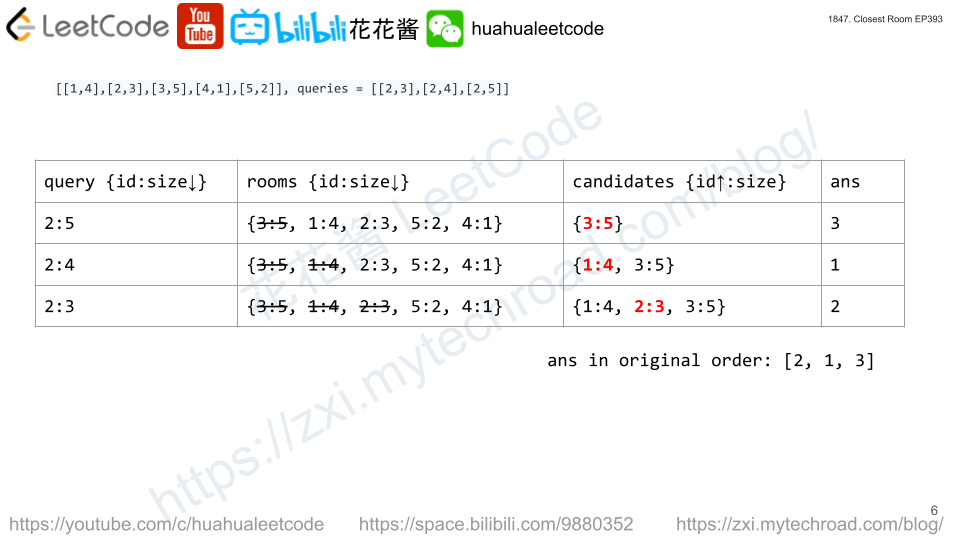
Input: rooms = [[1,4],[2,3],[3,5],[4,1],[5,2]], queries = [[2,3],[2,4],[2,5]]
Output: [2,1,3]
Explanation: The answers to the queries are as follows:
Query = [2,3]: Room number 2 is the closest as abs(2 - 2) = 0, and its size of 3 is at least 3. The answer is 2.
Query = [2,4]: Room numbers 1 and 3 both have sizes of at least 4. The answer is 1 since it is smaller.
Query = [2,5]: Room number 3 is the only room with a size of at least 5. The answer is 3.
Constraints:
n == rooms.length
1 <= n <= 105
k == queries.length
1 <= k <= 104
1 <= roomIdi, preferredj <= 107
1 <= sizei, minSizej <= 107
Solution: Off Processing: Sort + Binary Search
Time complexity: O(nlogn + mlogm) Space complexity: O(n + m)
Sort queries and rooms by size in descending order, only add valid rooms (size >= min_size) to the treeset for binary search.
You are given an array of positive integers arr. Perform some operations (possibly none) on arr so that it satisfies these conditions:
The value of the first element in arr must be 1.
The absolute difference between any 2 adjacent elements must be less than or equal to 1. In other words, abs(arr[i] - arr[i - 1]) <= 1 for each i where 1 <= i < arr.length (0-indexed). abs(x) is the absolute value of x.
There are 2 types of operations that you can perform any number of times:
Decrease the value of any element of arr to a smaller positive integer.
Rearrange the elements of arr to be in any order.
Return the maximum possible value of an element in arr after performing the operations to satisfy the conditions.
Example 1:
Input: arr = [2,2,1,2,1]
Output: 2
Explanation:
We can satisfy the conditions by rearranging arr so it becomes [1,2,2,2,1].
The largest element in arr is 2.
Example 2:
Input: arr = [100,1,1000]
Output: 3
Explanation:
One possible way to satisfy the conditions is by doing the following:
1. Rearrange arr so it becomes [1,100,1000].
2. Decrease the value of the second element to 2.
3. Decrease the value of the third element to 3.
Now arr = [1,2,3], which satisfies the conditions.
The largest element in arr is 3.
Example 3:
Input: arr = [1,2,3,4,5]
Output: 5
Explanation: The array already satisfies the conditions, and the largest element is 5.
Design a system that manages the reservation state of n seats that are numbered from 1 to n.
Implement the SeatManager class:
SeatManager(int n) Initializes a SeatManager object that will manage n seats numbered from 1 to n. All seats are initially available.
int reserve() Fetches the smallest-numbered unreserved seat, reserves it, and returns its number.
void unreserve(int seatNumber) Unreserves the seat with the given seatNumber.
Example 1:
Input
["SeatManager", "reserve", "reserve", "unreserve", "reserve", "reserve", "reserve", "reserve", "unreserve"]
[[5], [], [], [2], [], [], [], [], [5]]
Output

[null, 1, 2, null, 2, 3, 4, 5, null]

Explanation SeatManager seatManager = new SeatManager(5); // Initializes a SeatManager with 5 seats. seatManager.reserve(); // All seats are available, so return the lowest numbered seat, which is 1. seatManager.reserve(); // The available seats are [2,3,4,5], so return the lowest of them, which is 2. seatManager.unreserve(2); // Unreserve seat 2, so now the available seats are [2,3,4,5]. seatManager.reserve(); // The available seats are [2,3,4,5], so return the lowest of them, which is 2. seatManager.reserve(); // The available seats are [3,4,5], so return the lowest of them, which is 3. seatManager.reserve(); // The available seats are [4,5], so return the lowest of them, which is 4. seatManager.reserve(); // The only available seat is seat 5, so return 5. seatManager.unreserve(5); // Unreserve seat 5, so now the available seats are [5].
Constraints:
1 <= n <= 105
1 <= seatNumber <= n
For each call to reserve, it is guaranteed that there will be at least one unreserved seat.
For each call to unreserve, it is guaranteed that seatNumber will be reserved.
At most 105 calls in total will be made to reserve and unreserve.