Press "Enter" to skip to content

Huahua's Tech Road

花花酱 LeetCode 1609. Even Odd Tree

A binary tree is named Even-Odd if it meets the following conditions:

  • The root of the binary tree is at level index 0, its children are at level index 1, their children are at level index 2, etc.
  • For every even-indexed level, all nodes at the level have odd integer values in strictly increasing order (from left to right).
  • For every odd-indexed level, all nodes at the level have even integer values in strictly decreasing order (from left to right).

Given the root of a binary tree, return true if the binary tree is Even-Odd, otherwise return false.

Example 1:
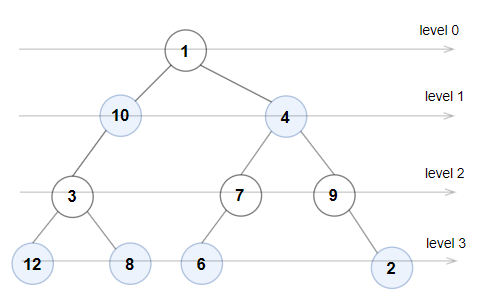
Input: root = [1,10,4,3,null,7,9,12,8,6,null,null,2]
Output: true
Explanation: The node values on each level are:
Level 0: [1]
Level 1: [10,4]
Level 2: [3,7,9]
Level 3: [12,8,6,2]
Since levels 0 and 2 are all odd and increasing, and levels 1 and 3 are all even and decreasing, the tree is Even-Odd.

Example 2:
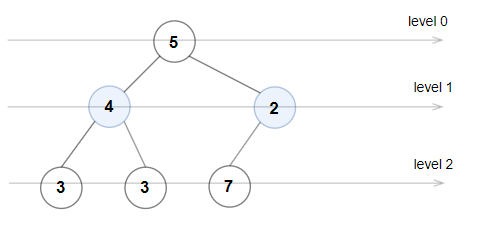
Input: root = [5,4,2,3,3,7]
Output: false
Explanation: The node values on each level are:
Level 0: [5]
Level 1: [4,2]
Level 2: [3,3,7]
Node values in the level 2 must be in strictly increasing order, so the tree is not Even-Odd.

Example 3:
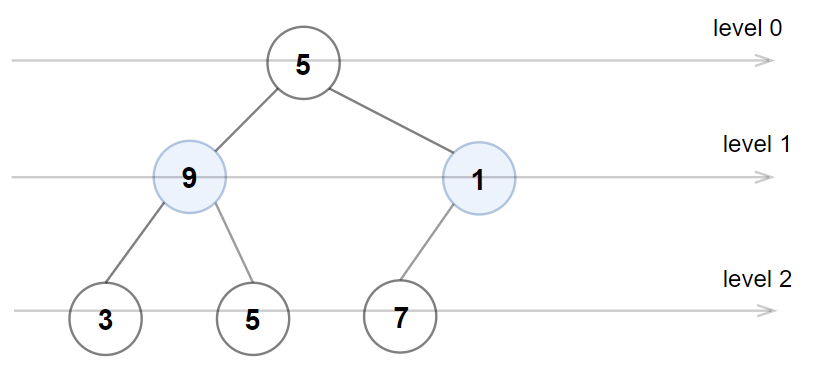
Input: root = [5,9,1,3,5,7]
Output: false
Explanation: Node values in the level 1 should be even integers.

Example 4:

Input: root = [1]
Output: true

Example 5:

Input: root = [11,8,6,1,3,9,11,30,20,18,16,12,10,4,2,17]
Output: true

Constraints:

  • The number of nodes in the tree is in the range [1, 105].
  • 1 <= Node.val <= 106

Solution 1: DFS

Time complexity: O(n)
Space complexity: O(n)

C++

Python3

Solution 2: BFS

Time complexity: O(n)
Space complexity: O(n)

Python3

花花酱 LeetCode 1608. Special Array With X Elements Greater Than or Equal X

You are given an array nums of non-negative integers. nums is considered special if there exists a number x such that there are exactly x numbers in nums that are greater than or equal to x.

Notice that x does not have to be an element in nums.

Return x if the array is special, otherwise, return -1. It can be proven that if nums is special, the value for x is unique.

Example 1:

Input: nums = [3,5]
Output: 2
Explanation: There are 2 values (3 and 5) that are greater than or equal to 2.

Example 2:

Input: nums = [0,0]
Output: -1
Explanation: No numbers fit the criteria for x.
If x = 0, there should be 0 numbers >= x, but there are 2.
If x = 1, there should be 1 number >= x, but there are 0.
If x = 2, there should be 2 numbers >= x, but there are 0.
x cannot be greater since there are only 2 numbers in nums.

Example 3:

Input: nums = [0,4,3,0,4]
Output: 3
Explanation: There are 3 values that are greater than or equal to 3.

Example 4:

Input: nums = [3,6,7,7,0]
Output: -1

Constraints:

  • 1 <= nums.length <= 100
  • 0 <= nums[i] <= 1000

Solution 1: Brute Force

Try all possible x from 0 to n.

Time complexity: O(n^2)
Space complexity: O(1)

C++

Python3

Solution 2: Counting Sort

Time complexity: O(n)
Space complexity: O(n)

f[i] := sum(nums >= i)

C++

花花酱 LeetCode 1606. Find Servers That Handled Most Number of Requests

You have k servers numbered from 0 to k-1 that are being used to handle multiple requests simultaneously. Each server has infinite computational capacity but cannot handle more than one request at a time. The requests are assigned to servers according to a specific algorithm:

  • The ith (0-indexed) request arrives.
  • If all servers are busy, the request is dropped (not handled at all).
  • If the (i % k)th server is available, assign the request to that server.
  • Otherwise, assign the request to the next available server (wrapping around the list of servers and starting from 0 if necessary). For example, if the ith server is busy, try to assign the request to the (i+1)th server, then the (i+2)th server, and so on.

You are given a strictly increasing array arrival of positive integers, where arrival[i] represents the arrival time of the ith request, and another array load, where load[i] represents the load of the ith request (the time it takes to complete). Your goal is to find the busiest server(s). A server is considered busiest if it handled the most number of requests successfully among all the servers.

Return a list containing the IDs (0-indexed) of the busiest server(s). You may return the IDs in any order.

Example 1:

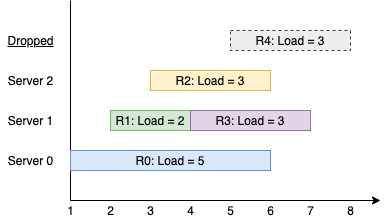
Input: k = 3, arrival = [1,2,3,4,5], load = [5,2,3,3,3] 
Output: [1] 
Explanation:
All of the servers start out available.
The first 3 requests are handled by the first 3 servers in order.
Request 3 comes in. Server 0 is busy, so it's assigned to the next available server, which is 1.
Request 4 comes in. It cannot be handled since all servers are busy, so it is dropped.
Servers 0 and 2 handled one request each, while server 1 handled two requests. Hence server 1 is the busiest server.

Example 2:

Input: k = 3, arrival = [1,2,3,4], load = [1,2,1,2]
Output: [0]
Explanation:
The first 3 requests are handled by first 3 servers.
Request 3 comes in. It is handled by server 0 since the server is available.
Server 0 handled two requests, while servers 1 and 2 handled one request each. Hence server 0 is the busiest server.

Example 3:

Input: k = 3, arrival = [1,2,3], load = [10,12,11]
Output: [0,1,2]
Explanation: Each server handles a single request, so they are all considered the busiest.

Example 4:

Input: k = 3, arrival = [1,2,3,4,8,9,10], load = [5,2,10,3,1,2,2]
Output: [1]

Example 5:

Input: k = 1, arrival = [1], load = [1]
Output: [0]

Constraints:

  • 1 <= k <= 105
  • 1 <= arrival.length, load.length <= 105
  • arrival.length == load.length
  • 1 <= arrival[i], load[i] <= 109
  • arrival is strictly increasing.

Solution: Heap + TreeSet

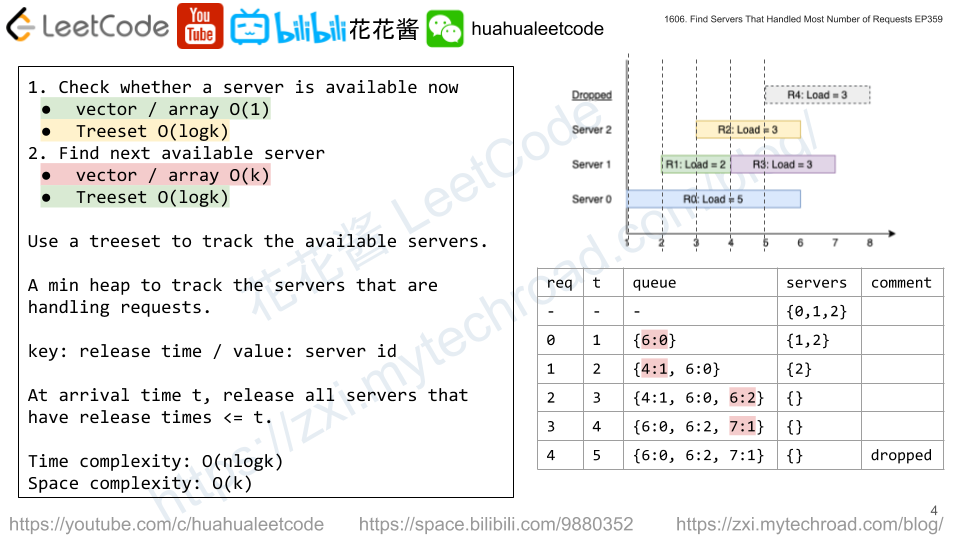
Use a min heap to store the release time -> server.
Use a treeset to track the current available servers.
For reach request, check whether servers can be released at that time.

Time complexity: O(nlogk)
Space complexity: O(k)

C++

花花酱 LeetCode 1605. Find Valid Matrix Given Row and Column Sums

You are given two arrays rowSum and colSum of non-negative integers where rowSum[i] is the sum of the elements in the ith row and colSum[j] is the sum of the elements of the jth column of a 2D matrix. In other words, you do not know the elements of the matrix, but you do know the sums of each row and column.

Find any matrix of non-negative integers of size rowSum.length x colSum.length that satisfies the rowSum and colSum requirements.

Return a 2D array representing any matrix that fulfills the requirements. It’s guaranteed that at least one matrix that fulfills the requirements exists.

Example 1:

Input: rowSum = [3,8], colSum = [4,7]
Output: [[3,0],
         [1,7]]
Explanation:
0th row: 3 + 0 = 0 == rowSum[0]
1st row: 1 + 7 = 8 == rowSum[1]
0th column: 3 + 1 = 4 == colSum[0]
1st column: 0 + 7 = 7 == colSum[1]
The row and column sums match, and all matrix elements are non-negative.
Another possible matrix is: [[1,2],
                             [3,5]]

Example 2:

Input: rowSum = [5,7,10], colSum = [8,6,8]
Output: [[0,5,0],
         [6,1,0],
         [2,0,8]]

Example 3:

Input: rowSum = [14,9], colSum = [6,9,8]
Output: [[0,9,5],
         [6,0,3]]

Example 4:

Input: rowSum = [1,0], colSum = [1]
Output: [[1],
         [0]]

Example 5:

Input: rowSum = [0], colSum = [0]
Output: [[0]]

Constraints:

  • 1 <= rowSum.length, colSum.length <= 500
  • 0 <= rowSum[i], colSum[i] <= 108
  • sum(rows) == sum(columns)

Solution: Greedy

Let a = min(row[i], col[j]), m[i][j] = a, row[i] -= a, col[j] -=a

Time complexity: O(m*n)
Space complexity: O(m*n)

C++

花花酱 LeetCode 1604. Alert Using Same Key-Card Three or More Times in a One Hour Period

Leetcode company workers use key-cards to unlock office doors. Each time a worker uses their key-card, the security system saves the worker’s name and the time when it was used. The system emits an alert if any worker uses the key-card three or more times in a one-hour period.

You are given a list of strings keyName and keyTime where [keyName[i], keyTime[i]] corresponds to a person’s name and the time when their key-card was used in a single day.

Access times are given in the 24-hour time format “HH:MM”, such as "23:51" and "09:49".

Return a list of unique worker names who received an alert for frequent keycard use. Sort the names in ascending order alphabetically.

Notice that "10:00" – "11:00" is considered to be within a one-hour period, while "23:51" – "00:10" is not considered to be within a one-hour period.

Example 1:

Input: keyName = ["daniel","daniel","daniel","luis","luis","luis","luis"], keyTime = ["10:00","10:40","11:00","09:00","11:00","13:00","15:00"]
Output: ["daniel"]
Explanation: "daniel" used the keycard 3 times in a one-hour period ("10:00","10:40", "11:00").

Example 2:

Input: keyName = ["alice","alice","alice","bob","bob","bob","bob"], keyTime = ["12:01","12:00","18:00","21:00","21:20","21:30","23:00"]
Output: ["bob"]
Explanation: "bob" used the keycard 3 times in a one-hour period ("21:00","21:20", "21:30").

Example 3:

Input: keyName = ["john","john","john"], keyTime = ["23:58","23:59","00:01"]
Output: []

Example 4:

Input: keyName = ["leslie","leslie","leslie","clare","clare","clare","clare"], keyTime = ["13:00","13:20","14:00","18:00","18:51","19:30","19:49"]
Output: ["clare","leslie"]

Constraints:

  • 1 <= keyName.length, keyTime.length <= 105
  • keyName.length == keyTime.length
  • keyTime are in the format “HH:MM”.
  • [keyName[i], keyTime[i]] is unique.
  • 1 <= keyName[i].length <= 10
  • keyName[i] contains only lowercase English letters.

Solution: Hashtable + sorting

Time complexity: O(nlogn)
Space complexity: O(n)

C++