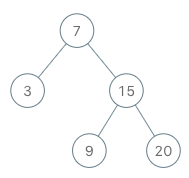
Implement the BSTIterator class that represents an iterator over the in-order traversal of a binary search tree (BST):
BSTIterator(TreeNode root) Initializes an object of the BSTIterator class. The root of the BST is given as part of the constructor. The pointer should be initialized to a non-existent number smaller than any element in the BST.
boolean hasNext() Returns true if there exists a number in the traversal to the right of the pointer, otherwise returns false.
int next() Moves the pointer to the right, then returns the number at the pointer.
Notice that by initializing the pointer to a non-existent smallest number, the first call to next() will return the smallest element in the BST.
You may assume that next() calls will always be valid. That is, there will be at least a next number in the in-order traversal when next() is called.
The DNA sequence is composed of a series of nucleotides abbreviated as 'A', 'C', 'G', and 'T'.
For example, "ACGAATTCCG" is a DNA sequence.
When studying DNA, it is useful to identify repeated sequences within the DNA.
Given a string s that represents a DNA sequence, return all the 10-letter-long sequences (substrings) that occur more than once in a DNA molecule. You may return the answer in any order.
Example 1:
Input: s = "AAAAACCCCCAAAAACCCCCCAAAAAGGGTTT"
Output: ["AAAAACCCCC","CCCCCAAAAA"]
Example 2:
Input: s = "AAAAAAAAAAAAA"
Output: ["AAAAAAAAAA"]
Constraints:
1 <= s.length <= 105
s[i] is either 'A', 'C', 'G', or 'T'.
Solution: Hashtable
Store each subsequence into the hashtable, add it into the answer array when it appears for the second time.
Time complexity: O(n*l) Space complexity: O(n*l) -> O(n) / string_view
There are 4 type of letters, each can be encoded into 2 bits. We can represent the 10-letter-long string using 20 lowest bit of a int32. We can use int as key for the hashtable.
You are given an integer array prices where prices[i] is the price of a given stock on the ith day, and an integer k.
Find the maximum profit you can achieve. You may complete at most k transactions.
Note: You may not engage in multiple transactions simultaneously (i.e., you must sell the stock before you buy again).
Example 1:
Input: k = 2, prices = [2,4,1]
Output: 2
Explanation: Buy on day 1 (price = 2) and sell on day 2 (price = 4), profit = 4-2 = 2.
Example 2:
Input: k = 2, prices = [3,2,6,5,0,3]
Output: 7
Explanation: Buy on day 2 (price = 2) and sell on day 3 (price = 6), profit = 6-2 = 4. Then buy on day 5 (price = 0) and sell on day 6 (price = 3), profit = 3-0 = 3.
Constraints:
0 <= k <= 100
0 <= prices.length <= 1000
0 <= prices[i] <= 1000
Solution: DP
profit[i][j] := max profit by making up to j sells in first i days. (Do not hold any share) balance[i][j] := max balance by making at to up j buys in first i days. (Most hold a share)
balance[i][j] = max(balance[i-1][j], profit[i-1][j-1] – prices[i]) // do nothing or buy at i-th day. profit[i][j] = max(profit[i-1][j], balance[i-1][j] + prices[i]) // do nothing or sell at i-th day.